
“As children of dawn himself, your kind were sovereign in this world, an entire realm sculpted by your tusks. Though, what becomes of a parent when they are no longer needed nor desired?
-Mahrruuri Tol, Amurran Scholar
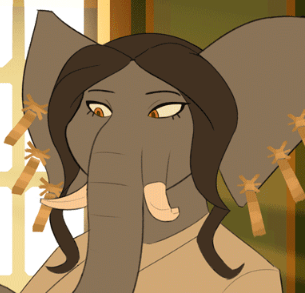
Mandanto, meaning “Dawn’s Child” in the ancient continental tongue, are a towering, furless species native to the heartlands of Hovehko. Renowned for their immense strength and innate wisdom, they hold the distinction of being the longest-lived species of any people. It is no surprise, then, the role Mandanto have played in shaping the world. Considered by many to be architects of civilization itself, their legacy is woven into the customs and culture of Hovehko, even the widely spoken Continental language traces its roots to the Mandanto.
Historically, the Mandanto have often risen to the pinnacle of society, most notably as the ruling class of the once-mighty Mandaskan Empire. However, their dominance has waned in recent times, challenged by the rise of self-determination among other species and their own declining numbers due to slow reproduction and shifting societal norms. These changes have stirred significant unrest across the continent and may signal the twilight of Mandanto hegemony.
Contents
Mandanto
Troph
Grazer
Height
10-15 feet (3-4.5m)
Weight
1-2 tons
Lifespan
Centuries
Physiology
Mandanto are notably unique in their appearance, characterized by their massive stature, prominent tusks, and elongated trunk. These features, unique among the peoples of Hovehko, have often fueled legends of their divine origin. Their skin tones range from tan to grey, and their ears vary in shape, with large, fan-like ears being the most common. Both male and female Mandanto can grow thick hair on their heads, typically dark brown to black in color.
As the longest-lived species, Mandanto have lifespans ranging from 250 to 300 years, with those reaching the upper limit considered exceptionally old. However, this longevity comes with a slower maturation process. Mandanto do not reach adulthood until the age of 50.
Society
Early Society
According to legend, Mandanto were created in the direct image of the Grand Architect Daunto, entrusted with a divine mission: to ignite the flame of civilization across the world. This sacred purpose inspired the Mandanto to establish the Mandaskan Empire, one of the oldest and largest empires in history.
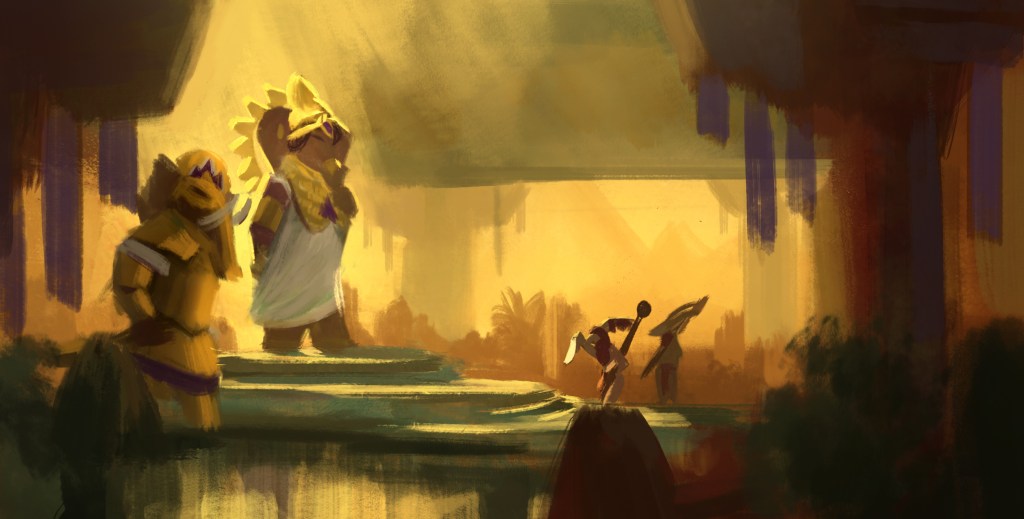
The empire would span the entire continent of Hovehko, with the Mandanto at the top of society. From the common calendar to the Continental language, Hovekish society was largely shaped by the Mandanto.
In the ancient Dawnterkellic era, the empire was led by a grand matriarch known as the Qohva, revered as the reincarnation of Daunto’s betrothed. The Qohva was believed to guide the now-sapient masses toward achieving the ideal civilization. Female Mandanto often held critical roles as administrators and religious leaders, while their male counterparts took on the responsibility of building cities and expanding territories. This duality was encapsulated in the age-old saying: “A man builds, a woman governs.”
Modern Strife
As the dark age of Sunderkell and the collapse of the Mandaskan Empire drew to a close, leaving its once-great capital in near ruin, the toll on the world’s population was immense. For the Mandanto, however, the aftermath was especially dire. Already a minority within their empire due to their slow growth cycles, they had relied heavily on their divine mandate to maintain dominance. But as the modern Tinderkellic era emerged, their grip on power weakened further.
Though the Qohva still exists, her role has shifted from political ruler to a figure of spiritual significance. She now governs only the successor Mandaskan nation in the Shintari province and serves as the head of the Shintaric faith.
Without the unifying political legitimacy of the Qohva, Mandanto-led splinter nations struggled to hold onto power. From Amurra to Siltria, their authority eroded, many Mandanto were stripped of their elite status, becoming ordinary citizens or, in more extreme cases, exiles to be sent back to Mandasko. While a few nations still cling to Mandanto rule, growing tensions and societal shifts cast doubt on their future. Only time will reveal whether the era of the Mandanto has truly reached its end.